Visual Evidence of an Agile Release
Last Updated on Wednesday, 12 June 2013 02:54 Written by Peter Callies Wednesday, 12 June 2013 02:54
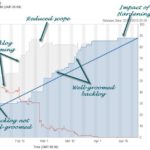
Below is a fancy release burnup chart (click it to see the full image) that visually shows the work of a team from a recent release by a LeadingAgile client.
The red line effectively is the amount of risk. You can see that the team started the release with about 50% of their stories unsized, but consistently drove that down through the first half of the release.
You can see the impact of end-of-release hardening in the flatness of the shaded blue area on the right side of the chart.
In the shaded gray area, you can see the team performing backlog grooming, breaking down the work into estimated stories and even cutting scope mid-release (the gray area increases as the red line decreases).
The flatness of the shaded blue area early in the release shows the impact of a backlog that isn’t well-groomed, but as the team drove that red line down, the blue area takes on a more-consistent positive slope.
Cool stuff that demonstrates the impact of a groomed backlog and the effectiveness of a team.
Learn More
Managing Expectations about Uncertainty
Last Updated on Friday, 16 November 2012 12:50 Written by Mike Cottmeyer Thursday, 10 September 2009 10:59
One of the biggest differences between the PMI crowd and the Agile crowd has to do with our expectations about uncertainty.
The PMI crowd generally believes that a Project Manager is supposed to manage uncertainty out of the project. The Agile crowd tends to believe that uncertainty and change is something that should be embraced. Rather than managing OUT uncertainty, the agilist chooses to manage FOR uncertainty.
This difference fundamentally influences how we go about the business of planning projects… the artifacts we create… and how we interact with and manage our teams. The reality is that both worldviews have a place depending upon your context and problem domain. It’s up to us [as Project Managers] to recognize the nature of the projects we are working on and choose the strategy most likely yield a desireable outcome… for both our project stakeholders and our external customers.
We cannot check our brains at the door and blindly follow ANY methodology. It’s up to us to assess our situation and choose an approach that is suitable for the task at hand.
Learn MoreYes… Agile Isn’t Project Managment…
Last Updated on Friday, 16 November 2012 12:51 Written by Mike Cottmeyer Sunday, 28 June 2009 03:47
…but it sure will change how you do project management.
I’ve got this talk called the Agile PMP: Teaching an Old Dog New Tricks. The first time I delivered the talk was last year at the Agile Development Practices conference in Orlando. So far this year I’ve done the talk for a few local groups here in Atlanta and then out in Vegas at the Better Software Conference and Expo. Later this year I’ll deliver the talk at Agile 2009 in Chicago, the PMI Global Congress in Orlando, and the Agile Development Practices Conference… also in Orlando.
I’ve been pretty pleased with how well the talk has been received by conference selection committees and by the attendance at the shows. The talk works because it helps people understand Agile in the context of what they already know. We talk a bit about what is the same… and we use that commonality to explore what is different. At the end of the day… regardless of whether we choose to a traditional approach or an agile approach… we still have to deal with the fundamentals of project management.
Agile projects have to have a way of dealing with the triple constraints… there has to be some concept of time… some concept of cost… and some concept of scope. We have to manage risk… decide how we are going to communicate… and how we are going manage quality. How we go about doing these things on an Agile project might be different, but we need to have a shared understanding of how all this stuff is going to be accomplished. By helping folks understand Agile in the context of the PMI process groups and knowledge areas… we provide a solid baseline of understanding.
My core message centers around the triple constraints and our typical assumptions about uncertainty. Most traditionally managed software projects begin by defining what we are going to build… by defining scope. Once we know what we want to build… then we’ll assess the requirements to see how much it is going to cost and how long it is going to take. There is always some acknowledgement of time and cost constraints up front… and there is negotiation with the stakeholders to get the three variables to converge… but starting with scope causes many software projects to start slow and finish even slower.
The problem happens when we go off and decide what we want to build without any idea of what it is going to take to build it. We create a wish list of things we’d like to have in the release and product managers get married to the ideas early on. It becomes tough to see how we can deliver value to market without everything we have spent all this time and energy to specify for the development team. I have worked on projects that needed to be delivered in six months and the product team created over five years worth of requirements.
When you push back… the discussion usually goes something like… well just do the estimate and tell us how much we can get. The problem is that it takes time to learn enough about the set of possible solutions to actually do an estimate… there might be technical dependencies… there are clearly resource dependencies… so evaluating a multi-year project to determine what can be delivered in the next six months can be a huge waste of time and resources. This problem is further compounded by changing market needs and the fact that software has a tendency to evolve… a lot… as it is actually built.
We create a false sense of certainty about what it is we are going to build and when we can get it done. Once time and cost commitments are made… being married to a fixed set of requirements is going to get in trouble. There has to be some room to negotiate as we go.
While Agile is not a project management methodology… it does impact how we do project management… mainly because Agile is going to have us make a different set of assumptions about our project constraints. Now… just like anything… these new assumptions and constraints need to be validated in your specific environment… but in general… on Agile projects we are going to decide that scope is not the primary driver. Rather than starting with scope… we are going to start with time and cost. We decide first when we need to go to market and how much we are willing to spend to get a product out the door.
Rather than create a giant wish list of features… we are going to start defining features to fill the time and money allotted. When we have filled up the time… and planned to spend all the money… we have to decide if we have a release that could be taken to market. There is a very subtle difference at play. There is still negotiation… still an assessment of the viability of the release… its just that we don’t spend time assessing features that have no chance in hell of actually getting implemented.
In effect, we are talking about what agilists call product planning and release planning. We create a product plan… a roadmap… that gives us some confidence around what the customer is going to get… when they are going to get it… and what it will cost. The main difference is that we are starting with time and cost and figuring out what we are going to build within those pre-defined constraints.
Just because we started with time and cost… that does not mean that we can fix scope… we need some room due to our new assumptions about the certainty of our estimates and the stability of our requirements. Again… we are going to start with the notion that time and cost are our primary constraints and that we’ll want to fine tune the scope as we go to deliver the greatest business benefit possible. Because we deliver working code on short cycles… and we have empirical evidence of our progress… we can constantly evaluate how we are doing against where we hoped to be. The project stakeholders have the ability to control the project… either by adjusting scope… or by adjusting the time and cost constraints… in real time as the project is progressing.
If at any time we learn that the business objectives and ROI targets cannot be met… we have the opportunity to kill the project… or radically alter its course… having invested as little as possible to make that decision. We are using the real data… being generated by real teams… writing real software… to provide feedback into the higher level roadmap. It really does put the business back in the driver seat. This idea that we are just going to start building software and let the backlog emerge.. the architecture emerge… and product emerge isn’t workable in most contexts.
With all the talk of late regarding Kanban and single piece flow… I wonder if we will lose the ability to make any kind of commitment back to the business. I think that in some contexts… this is probably appropriate. In many though… we will still need to have the concept of roadmaps… vision… release plans… and product backlogs. I don’t see these things as waste… but more as an acceptable level of overhead to give the business some idea of what they are going to get… when they are going to get it… and what it will cost when we get there.
So… again… we find that Agile is not a one size fits all strategy. We have to use our brain… we have to use ALL the tools and practices and principles we have at our disposal… we have to come up with the best approach to deliver the project given the constraints the business has imposed. At the end of the day… we are still doing project management… its just that agile changes the game a bit and introduces a new set of tools… and a new set of assumptions… and a new set of constraints which we’ll use to deliver projects in more uncertain environments.
Learn MoreCatching Back Up…
Last Updated on Friday, 16 November 2012 12:51 Written by Mike Cottmeyer Tuesday, 23 June 2009 01:01
I can’t believe it has been over two weeks since I did my last blog post. Longer than that if you are an Agile Chronicles reader. The past few weeks have been a bit nuts.
As you guys know… the week before last I was in Vegas to do my Agile PMP talk. The talk went well but it is always entertaining to see how the dynamic in the room changes depending on who decides to speak up. I need to get better at avoiding language that can set people off
Anyway… every time I get to deliver this presentation in front of people it helps sharpen the message.
The Agile PMP talk just got picked up by the PMI Global Congress in October… so I better get better fast. I am not expecting that crowd to show any mercy!
Last week I was with my two older boys at Rainey Mountain Scout Camp. Camp sure has changed since I was a kid. I didn’t have a cell signal the whole week but there were several wifi hotspots around so I was not without some connectivity. After getting the troop off to classes… I spent each morning online and then each afternoon hiking in the North Georgia mountains. I would rather sleep in a tent than a swanky hotel… so life was good.
Before I left… we talked a bit about how it is so easy to get focused on how we are getting work done and to lose focus on what we are actually delivering. That problem has to be pretty universal… it applies to software teams and complex organizations… it also applies to scout troops. Are we here to build committees and sign paperwork or to help boys become young men? When we start focusing on how things are going to get done… it is easy to lose focus on what is really important. But… I digress.
Some of my writing focus lately has been directed in places other than this blog:
Next month I am publishing my first executive report for the Cutter Consortium. I did the report with my good friend Dennis Stevens. Dennis is a really smart guy and we pushed each other on the ideas in this paper. The report is only available to Cutter Consortium subscribers but maybe we’ll have a raffle here on Leading Agile to give out a hard copy.
I’ve also done a short whitepaper for VersionOne on the role of the Agile Project Manager. It is an introductory piece but you guys might want to check it out. The paper talks not so much about Agile Project Management… but more about the new skills a Project Manager needs in an agile environment and how they need to think about their role a little differently. This paper can be downloaded for the low, low cost of giving the VersionOne sales team your contact information.
Lastly, keep your eyes peeled for a screen cast I put together on agile adoption. Naming talks is not really my strong suit. The screen cast is on adopting agile… but more fundamentally it is about teams… and how to build organizations around teams… and how to decide what teams work on… and how to throttle work through the organization in a way that creates flow. So while this is an agile talk… it also hits on things like capability analyis and lean scheduling in the enterprise.
I’ll shoot a link once we have the presentation up and publicly available. Hopefully, I’ll get back in the groove of writing this week… still have lot’s to say